Showing posts with label MKH. Show all posts

Tuesday, 26 May 2020

Are You A Contrarian or Trend Investor?


"Be greedy when others are fearful, be fearful when others are greedy"

This is a famous quote by Warren Buffet. He can't be wrong, right?

Mr Fong SiLing (Cold Eye), apparently, also adopted this strategy. He mentioned again and again in his articles that the best way to profit from stock market investing is to practice contrarian investing (反向投资)

Based on his 40 years of experience and success, he can't be wrong as well.


Contrarian Investing: Going Against The Grain • Novel Investor


Recently he openly wrote that it is a good time to collect oil & gas stocks now. Oil price is at rock bottom, and so are many O&G stock prices. Everyone seems to be pessimistic about O&G now.

We know that eventually oil price will recover. O&G stocks price will recover as well, if they can survive the storm.

How long will it take for crude oil price to recover then? Can it be within 1 year, or 2-3 years? No one knows. 

Brent crude oil price has been in the downtrend since falling from above USD100 per barrel in mid 2014. It rebounded in 2016 from USD30 to reach USD80 in 2018. Then it fell below USD30 this year.

We know that it will go back to above USD60 per barrel again. It's just a matter of time.

By collecting good O&G stocks, you know that you are almost sure win, and may win big. However, how long are you willing to wait?

Are you willing to wait for 2-3 years? 

Some investors have no problem with that, and surely some do not have the patience.
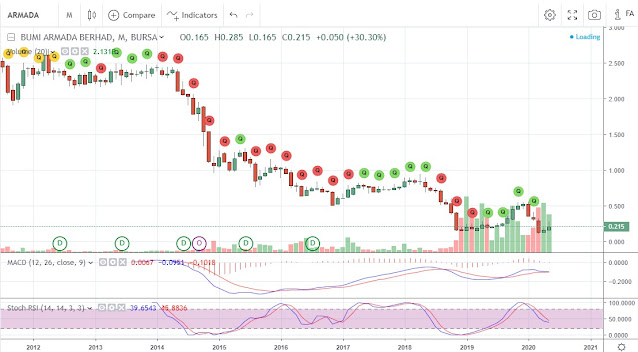
       Armada: Downtrend for 6 years and counting


Besides O&G sector, there are other sectors which are also languishing in bear zone such as plantation, property, logistics etc.

Is it the time to collect stocks in those sectors as well? Now everyone is "fearful" in them, should we act now?

Stock market investing is like predicting the future earning of a company. For me, if you think that the recovery is close, then may be it's time to buy.

How close is "close"? Everyone has their own definition for that.

Property sector was hot in the early 2010s. New development projects were like mushrooms after rain and all were fully taken up. Property price went up like hell. A lot of non-property players diversified to join this property boom.

As a result, many property stocks at that time double or triple in price. 

The turning point was around 2015, when there was an oversupply of properties in the market, and the property price were unaffordable to many.

From that point of time, property sales dropped, company's profit dropped and the share price inevitably followed.


MKH: Property & Plantation
       MKH: Property + Plantation Play


Up to today, I still don't see any recovery hope for property stocks in the next 12 months. Covid-19 just makes the situation worse.

Nevertheless, after Covid-19's concern is over, would it be the time for property sector to turnaround amid low interest environment? 

I don't know when will this happen but my point is, buying property stocks in year 2016, 2017, 2018 or 2019 when most people were "fearful" in property sector is a contrarian move, but is it a good move?

I have a few property stocks before, and I have sold all of them except Matrix which I decided to keep.

The reason is simple, I foresee Matrix can continue to break new high in sales and profits even though the overall property market is going down hill.

To me Matrix is a well-managed company. It makes good sales, its unbilled sales go up and it gives good dividends too.

True enough, Matrix's sales and net profit increase year after year since listing in 2013. However, its share price has been quite stagnant in the last 4-5 years before Covid-19 dragged it down in Mac20.

It didn't drop like other property stocks though, but it didn't go up. So, its PE ratio is getting lower and lower at around 6x.

The reason is, Matrix is not in the positive "trend".

This brings us to "Trend Investing".

From my observation, trend investing is a good way to earn money in stock market, especially if you can identify the trend earlier than most people do.

So it means that doing homework does matter, not like rushing in when everyone already did so.

Currently it is the trend of gloves and PPE related stocks. If you are smart and alert, you might have bought and accumulated gloves stocks in Jan/Feb this year when Covid-19 started to spread globally, even though the jump in stock price only occurred in April.

Up to today I still haven't got any shares of glove stocks, mainly because I was slow to react, and most of the good glove stocks are "expensive" to me.

If you buy early in the trend, you just ride on it and make handsome profit. However, if you buy near the end of the trend, you might end up losing money.

The trend can last for few months to few years.

Last time the property trend lasted about 3 years from 2012-2015. If I'm not wrong, plantation stocks were also hotly debated at that time.

After that in 2014, the tremendous weakening of Ringgit against USD from RM3.20 to RM4.40 kick started the uptrend of export-orientated stocks.

Furniture, injection moulding, semiconductor and other export stocks were having a real good time.


       POHUAT: Furniture export stock 


This trend also lasted around 3 years until 2017 when MYR strengthened to below RM4.00. 

Last year there seems to be a brief box-packaging trend. Combination of several favourable conditions such as higher demand, lower raw material cost and promotion by some investors and analysts might have initiated and sustained the trend.

This trend lasted for about a year before being cut short by Covid-19.

How about the trend of technology stocks? Smartphones, 5G, IoT, cloud computing, driverless cars etc are the main trend of the world so I feel that it is always in the trend.

Even though we read that semiconductor industry has up and down cycle, or negatively affected by geopolitical issues, I actually don't feel any significant "out-of-trend" issue for the past 10 years.

When a tech company goes down hill, there will be another tech company on the up at the same time.

The important thing is to make sure that the tech company is always at the latest trend of technology. If not, it will be eliminated sooner or later.


       INARI: Uptrend from 2013 until 2018


Contrarian and trend investing seem to be two different kinds of investment strategies. Both can make money and lose money as well.

If you buy too early in contrarian investing, you lose time, and time is money.

If you buy too late in trend investing, you can be trapped and lose money.

No matter which kind of investors you are, it's all about the timing.

Those successful investors excel in the in & out timing, either using fundamental, technical, trend, contrarian or whatever methods.

We know that life is extremely tough for Airasia & GENM now. We also know that both of them will recover. 

Are you greedy now when others are fearful?
 

Thursday, 10 December 2015

Oil Palm Rising Star: MKH

MKH, a property developer based in Klang Valley, diversified into oil palm plantation in Jan 2008 when it acquired 100% of SJL Utama Pte Ltd which has 95% stake in PT Khaleda Agroprima Malindo who owns 15,942 hectares of plantation land in East Kalimantan.

It started its planting program straight away and it was completed in just 4 years time.

The table below shows MKH's total planted area reported in its annual report.

Year New Planting (ha) Total Planting (ha)
2008 3500 3500
2009 6000 9500
2010 4300 13800
2011 1400 15200
* Total planted area revised to 14,400ha in 2013


Its first palm oil mill with capacity of 60MT/hour was completed in 2011.

CPO was first produced and sold in year 2012 which generated its first revenue from plantation at RM44.9mil.

It was also the first time its operating profit turned positive (RM660k) since it ventured into plantation business 5 years ago.

In FY2013 (ended 30 Sep13), MKH revised its total planted area to 14,400 ha, down from 15,200 ha reported previously.

Its FFB yield improved to 16.0 MT/ha in 2013 from 11.6 MT/ha in 2012 as more trees turned mature.

Its OER also rose from 19.5% to 21.7% in the same period of time.

In FY2014, its FFB yield and OER improved further to 21 MT/ha and 22% respectively.

FFB harvested in FY14 stood at 295,000MT, up from 222,000MT a year ago.

The figure reached 370,000MT in FY15.

It has also completed its POM upgrade to 90 MT/h in 2014.

CPO & palm kernel sales volume increased from 76,600MT in FY14 to 108,900MT in FY15.

The table below shows MKH's past performance in its plantation segment (in RM mil):

FY Revenue PBT PAT Adj PBT
08 0 -2.4 -2.3
09 0 -4.6 -5
10 0 -4.5 -4.3
11 0 -8.7 -6
12 44.9 0.07 -1.6
13 101.1 -44.9 -36.9 4.7
14 164.8 22.2 14.9 40.3
15* 209.5 -29.7
7.3
* not audited


As expected, revenue from plantation segment increased progressively & brilliantly since year 2012 as more trees entered maturity.

However, its earnings were quite disappointing as it suffered pre-tax losses most of the time due to forex loss caused by significant weakening of IDR & MYR against USD in recent years.

Excluding this forex loss, it actually registered pre-tax profit in 4 consecutive years since FY12.

Its adjusted PBT (exclude forex) in most recent FY15 dropped 80% compared to FY14 despite higher revenue, mainly due to significant weakening of CPO price.

So, oil palm plantation business could be unpredictable because of fluctuating CPO price and forex issue as debt is usually high due to high capex.


As a rule of thumb, we expect oil palm tree to become mature and ready for harvest after 3 years (young mature) and reach prime mature after 8 years.

Since MKH started planting in 2008 and completed planting in 2011, its tree age will range from 5 to 8 years old now in 2015.

All the trees started to be harvested but most still haven't reach prime age.

So we can expect its FFB production to grow further for another 3-4 years until it reaches a plateau.

I think FFB yield of 25 MT/ha once fully matured is a very good yield. If we apply this yield to MKH's 14,400 ha plantation size, we can get 360,000MT a year.

However, its FFB produced is already at 370,000MT in FY15 even the trees are not in their prime age...


Subsequently , MKH will enjoy the recurring income from sales of CPO/kernel with minimal extra cost for another 15-20 years.

If the CPO price is high, then it will earn more. If CPO price fall, it will earn less.

I feel that MKH is an efficient planter as it could finished its planting program as planned. Most planters set a planting target but ends up planting less than half of target.

Besides, its FFB yield and OER are quite impressive given the fact of its average tree age is just about 6-7 years.

The less attractive part of MKH's plantation segment is that it has stopped planting since 2012 as there is no more plantation landbank.

Its 14,400 ha of plantation size is also relatively small.

It might acquire more landbank for plantation in the future but the growth has been interrupted.

MKH is supposed to to have a tough time in 2015 as both property and plantation sectors in Malaysia are suffering during this time.

However, its property segment actually did extremely well with record-breaking sales of RM850mil in FY15, up from about RM820mil in FY13.


Its property unbilled sales also reached a record high at RM920mil as at end of Sep15, compared to RM823mil at end of FY14.

So, we can expect its core profit to increase in the next few years, contributed by both property & plantation segments.

MKH recently expanded its development landbank by acquiring 130 acres of land in Kajang for RM239mil which is payable to land owners in 8 years.

This land has an estimated GDV of RM1bil and it will boost MKH's future GDV to RM12bil.

Its recent collaboration with PanaHome also looks interesting.


For its FY15 ended Sep15, MKH's revenue breached RM1bil mark for the first time, but PATAMI drops 17.5% from RM104.7mil to RM86.3mil.


However, FY15 is undoubtedly its best year if we factor in higher forex loss of RM37mil in its plantation segment (RM18mil loss in FY14) and lower fair value gain of RM9mil in its hotel/property investment segment (RM22mil gain in FY14). 

As I don't expect MYR/IDR to weaken like 2015 in 2016, MKH's bottom line is very likely to break new high in the next 2 years.

Personally I would expect its FY16 PATAMI to be at least RM100mil. This means projected EPS of at least 23.8sen base on 420mil shares.

As at end FY15, its net debt/equity ratio is 0.48, NTA RM2.63 and its operating cash flow is good.

Current share price of RM2.34 is not too high in my opinion.

After breaking new property sales record, can it better it or at least maintain this sales level in the coming years? This remains a little concern to me.

However, with its strategic landbank and high future GDV, the long term prospect of its property segment should be good.

As for its plantation segment, it's in autopilot mode.

Monday, 23 June 2014

Scientex: Best Ever Quarter, Again.

Scientex FY14Q3 Financial Result

SCIENTEX FY14Q3 FY14Q2 FY14Q1 FY13Q4 FY13Q3
Revenue 426.8 383.5 364.8 371.2 345.1
PBT 48.1 44.4 37.8 40.2 38.2
PBT% 11.3 11.6 10.4 10.9 11.1
PAT 37.2 33.9 29.3 30.3 29.5


Manu Rev 317.2 288.5 289.2 277.4 275.3
Manu OP 16.4 15.9 17.7 20.6 16.7
Prop Rev 109.6 95.0 75.6 93.8 69.8
Prop OP 32.5 29.3 22.2 31.4 23.3


Total Equity 686.2 649.9 635.9 628.7 584.8
Total Assets 1333.2 1304.4 1263.1 1286.4 1180.9
Trade Receivables 274.8 251.7 209.7 195.5 211.1
Inventories 82.1 76.3 86 80.7 73.5
Cash 56.4 89.3 91.2 152.2 58.6
Prop Dev Cost 71.8 74.4 57.5 68.5 56.4


Total Liabilities 624.9 633.3 606.8 637.7 577.6
Trade Payables 238.9 214.2 229.4 258.4 221.3
ST Borrowings 179.1 205.8 167.9 167.6 143.8
LT Borrowings 156.2 163.7 164.3 167.8 168.4


Net Cash Flow -95.8 -62.9 -61 115.8 22.3
Operation 89.5 30.9 13.5 209.7 131.4
Investment -106.7 -67.0 -54.1 -345.0 -325.2
Financing -78.6 -26.8 -20.4 251.2 216.1


EPS 16.43 15.34 13.27 13.80 13.73
NAS 3.1 2.94 2.88 2.84 2.72
D/E Ratio 0.41 0.43 0.38 0.29 0.43


For its FY14Q3, Scientex's revenue and PATAMI increase 23.7% and 26.1% respectively YoY. For 9 months of FY14, revenue at RM1.18bil is 36.9% higher compared to corresponding period of FY13, while 9-months PATAMI at RM99.6mil also increases 21.8% in the same period.

The better results are contributed by both manufacturing and property arms, in which both register better sales helped by better demand.

Cash is depleted in current quarter mainly due to capital expenditure and repayment of loans. Operation cash flow is still good though FY13 was even better. Thus, net debt to equity ratio improves slightly from 0.43 to 0.41.

Everything in Scientex still looks good for me except its profit margin in manufacturing division. Anyway, Scientex manage to achieve a stable overall PBT margin of around 11%.

Its operating margin in property segment has been good at above 30% in line with other developers. However, its manufacturing segment only registers an operating margin of 5-6% (5.6% in FY14Q3). This might be due to lower margin from industrial packaging.

Scientex's major competitor Daibochi which is mainly in consumer packaging industry achieves an operating margin of 10.3% in its latest quarter ended Mac14.

With the significant increase in the capacity of its blown film lines in consumer packaging acquired from GW Plastic, hopefully the overall margin in manufacturing can improve.

Property segment continues to perform well with unbilled sales of RM569mil at the end of FY14Q3. It still has 979 acres of development land with outstanding GDV of RM5.6 billion.


      Boosted by Scientex Senai


For simple comparison, MKH has a potential GDV of RM8 billion from 1,326 acres of land.

With better than expected result (for me) of  RM99.6mil net profit attributable to shareholders after 9 months, improved manufacturing capacity since 2014, and traditionally strong quarter in Q4, I will raise my FY14 earning forecast for Scientex to RM140mil (from RM120mil).

With total shares of 230mil, estimated EPS will be 60.9sen, and target price will be RM7.30 base on PE ratio of 12x for FY14.

Daibochi is currently trading at PE of 18.4x, while MKH is at 16x.

Nevertheless, I don't think MKH is expensive at the moment because its plantation segment will experience exponential growth starting from this year.


Scientex has announced an interim single tier dividend of 8sen for FY14 which ends in July14. Normally it will pay dividend 2 times a year. The next announcement is expected soon around October.

With a dividend payout policy of at least 30% of net profit, I expect Scientex to pay at least total 19sen dividend for its FY14.

A total of 26sen dividend was paid for FY13 including a special dividend for the first time since 2007. This represents a payout of 54%. Will Scientex pay special dividend again this year?

If it is to payout 50% as dividend, then it will be about 30sen per share. This translates into a good yield of 5.2% even at current share price of RM5.90.

Scientex's shares are rather illiquid with only 230mil of outstanding shares in the market, and the top 30 shareholders are holding 70% of them according to 2013 annual report.

With the abundance of retained profits in its equity, it is very much capable of giving bonus issues anytime.


I think Scientex has done a good job in expanding its business and enhancing shareholders' value. It was proven for the past 45 years. Hopefully it can be continued in the future.