Showing posts with label Fundamental. Show all posts

Tuesday, 18 August 2020

Am I A True Value Investor?

Warren Buffett Singapore Footprint In 2013

The answer is NO. 

Why I say so? Just look at my past completed trades since 2013 in "History" page, will any true value investors invest in companies like Geshen, HHGroup, Jadi, Asiapac, Daya, Complete, Notion & Adventa?

I read and heard from other teachers that in fundamental investment, one should invest in well-established, industry leading type of companies with competitive edge or margin of safety.

In my previous investment portfolio, you won't see any big cap companies and blue chips.

Value investors usually won't invest in loss-making companies with no presentable track records but I still put my money in them.

Tuesday, 26 May 2020

Are You A Contrarian or Trend Investor?


"Be greedy when others are fearful, be fearful when others are greedy"

This is a famous quote by Warren Buffet. He can't be wrong, right?

Mr Fong SiLing (Cold Eye), apparently, also adopted this strategy. He mentioned again and again in his articles that the best way to profit from stock market investing is to practice contrarian investing (反向投资)

Based on his 40 years of experience and success, he can't be wrong as well.


Contrarian Investing: Going Against The Grain • Novel Investor


Recently he openly wrote that it is a good time to collect oil & gas stocks now. Oil price is at rock bottom, and so are many O&G stock prices. Everyone seems to be pessimistic about O&G now.

We know that eventually oil price will recover. O&G stocks price will recover as well, if they can survive the storm.

How long will it take for crude oil price to recover then? Can it be within 1 year, or 2-3 years? No one knows. 

Brent crude oil price has been in the downtrend since falling from above USD100 per barrel in mid 2014. It rebounded in 2016 from USD30 to reach USD80 in 2018. Then it fell below USD30 this year.

We know that it will go back to above USD60 per barrel again. It's just a matter of time.

By collecting good O&G stocks, you know that you are almost sure win, and may win big. However, how long are you willing to wait?

Are you willing to wait for 2-3 years? 

Some investors have no problem with that, and surely some do not have the patience.

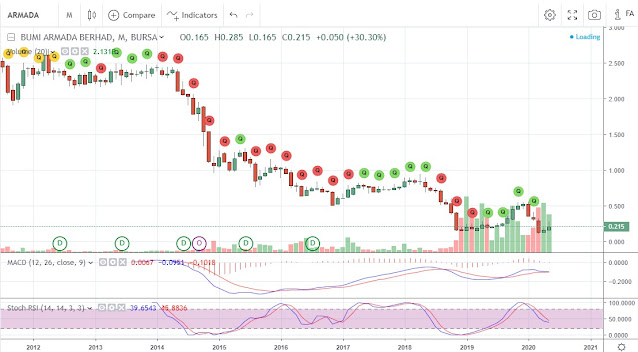
       Armada: Downtrend for 6 years and counting


Besides O&G sector, there are other sectors which are also languishing in bear zone such as plantation, property, logistics etc.

Is it the time to collect stocks in those sectors as well? Now everyone is "fearful" in them, should we act now?

Stock market investing is like predicting the future earning of a company. For me, if you think that the recovery is close, then may be it's time to buy.

How close is "close"? Everyone has their own definition for that.

Property sector was hot in the early 2010s. New development projects were like mushrooms after rain and all were fully taken up. Property price went up like hell. A lot of non-property players diversified to join this property boom.

As a result, many property stocks at that time double or triple in price. 

The turning point was around 2015, when there was an oversupply of properties in the market, and the property price were unaffordable to many.

From that point of time, property sales dropped, company's profit dropped and the share price inevitably followed.


MKH: Property & Plantation
       MKH: Property + Plantation Play


Up to today, I still don't see any recovery hope for property stocks in the next 12 months. Covid-19 just makes the situation worse.

Nevertheless, after Covid-19's concern is over, would it be the time for property sector to turnaround amid low interest environment? 

I don't know when will this happen but my point is, buying property stocks in year 2016, 2017, 2018 or 2019 when most people were "fearful" in property sector is a contrarian move, but is it a good move?

I have a few property stocks before, and I have sold all of them except Matrix which I decided to keep.

The reason is simple, I foresee Matrix can continue to break new high in sales and profits even though the overall property market is going down hill.

To me Matrix is a well-managed company. It makes good sales, its unbilled sales go up and it gives good dividends too.

True enough, Matrix's sales and net profit increase year after year since listing in 2013. However, its share price has been quite stagnant in the last 4-5 years before Covid-19 dragged it down in Mac20.

It didn't drop like other property stocks though, but it didn't go up. So, its PE ratio is getting lower and lower at around 6x.

The reason is, Matrix is not in the positive "trend".

This brings us to "Trend Investing".

From my observation, trend investing is a good way to earn money in stock market, especially if you can identify the trend earlier than most people do.

So it means that doing homework does matter, not like rushing in when everyone already did so.

Currently it is the trend of gloves and PPE related stocks. If you are smart and alert, you might have bought and accumulated gloves stocks in Jan/Feb this year when Covid-19 started to spread globally, even though the jump in stock price only occurred in April.

Up to today I still haven't got any shares of glove stocks, mainly because I was slow to react, and most of the good glove stocks are "expensive" to me.

If you buy early in the trend, you just ride on it and make handsome profit. However, if you buy near the end of the trend, you might end up losing money.

The trend can last for few months to few years.

Last time the property trend lasted about 3 years from 2012-2015. If I'm not wrong, plantation stocks were also hotly debated at that time.

After that in 2014, the tremendous weakening of Ringgit against USD from RM3.20 to RM4.40 kick started the uptrend of export-orientated stocks.

Furniture, injection moulding, semiconductor and other export stocks were having a real good time.


       POHUAT: Furniture export stock 


This trend also lasted around 3 years until 2017 when MYR strengthened to below RM4.00. 

Last year there seems to be a brief box-packaging trend. Combination of several favourable conditions such as higher demand, lower raw material cost and promotion by some investors and analysts might have initiated and sustained the trend.

This trend lasted for about a year before being cut short by Covid-19.

How about the trend of technology stocks? Smartphones, 5G, IoT, cloud computing, driverless cars etc are the main trend of the world so I feel that it is always in the trend.

Even though we read that semiconductor industry has up and down cycle, or negatively affected by geopolitical issues, I actually don't feel any significant "out-of-trend" issue for the past 10 years.

When a tech company goes down hill, there will be another tech company on the up at the same time.

The important thing is to make sure that the tech company is always at the latest trend of technology. If not, it will be eliminated sooner or later.


       INARI: Uptrend from 2013 until 2018


Contrarian and trend investing seem to be two different kinds of investment strategies. Both can make money and lose money as well.

If you buy too early in contrarian investing, you lose time, and time is money.

If you buy too late in trend investing, you can be trapped and lose money.

No matter which kind of investors you are, it's all about the timing.

Those successful investors excel in the in & out timing, either using fundamental, technical, trend, contrarian or whatever methods.

We know that life is extremely tough for Airasia & GENM now. We also know that both of them will recover. 

Are you greedy now when others are fearful?
 

Tuesday, 9 September 2014

Stocks Valuation Methods

There are many ways to valuate a stock or investment. I search the internet and here are what I found and learned so far.

Stock valuation involves basically fundamental analysis. Some might say that technical analysis can be used to valuate a stock but I think it is more like to valuate stock price.

Whether it is fundamental or technical, there is no right or wrong as long as you know crystal clear what you are doing. Investors should find out themselves what really suit them.

For me, I believe that fundamental is the way to go.


Valuation methods from fundamentals can be divided into two groups:
  • Absolute valuation method
    • To find out the intrinsic (true) value of a company, and no need to compare with others
    • Eg. dividend discount model, discounted cash flow model, assets based model etc
  • Relative valuation method
    • To compare companies in the same sector, to find out which is more "undervalued" relative to others
    • Eg. P/E ratio, P/B ratio, PEG ratio, ROE, ROA, ROIC, EVM etc


Absolute valuation method

Dividend Discounted Model (DDM)
  • Basis: Dividend represents actual cash flow that will return to shareholders from an investment, ie. we put in our money and get our return in the form of dividend.
  • DDM uses predicted dividend growth rate to arrive at a present stock value
  • Only suitable for companies that pay consistent dividends
  • Dividends payout should be stable and predictable
  • Formula:


Discounted Cash Flow (DCF)
  • Basis: Free cash flow (FCF) represents actual return to shareholders from an investment
  • DCF uses future FCF projections and discounts them to arrive at a present value
  • FCF should be positive and predictable (not so suitable for growth companies with large capex)
  • Formula:


Net-net / Net Current Assets Value (NCAV)
  • Basis: Valuate a company solely on its net current assets
  • Introduced by Benjamin Graham
  • Formula


Book Value / Net Tangible Assets (NTA)
  • Basis: Valuate a company base on its net assets
  • Some investors include & some exclude intangible assets
  • Book value  = Total Assets - (Intangible Assets) - Total Liabilities
  • Book value should be compared to share price


Revalued Net Assets Valuation (RNAV)
  • Basis: Valuate a company base on market value of its assets such as land, buildings, business, investment etc.
  • Total market value of assets divided by outstanding shares to get RNAV per share.
  • Commonly used for property stocks

       Example of RNAV


There is another valuation method which is commonly mentioned when I read analyst reports, which is the Sum-Of-Parts valuation (SOP).

Sounds like Son-Of-XX?

It is suitable for companies with 2 or more business divisions, in which every divisions are valuated separately and then combined. The valuation method used for each divisions can be different.

I think it is best explained with example (by MIDF Research)

       Example of SOP Valuation

According to experts, there is no single best valuation method. However, some method may be more suitable for certain types of companies or businesses.

As many of those valuation methods are base on assumption and prediction of future earning, future cash flow, future dividend etc, it may not be very accurate.

Thus, investors usually set a discount rate or margin of safety to minimize the downside risk when making an investment.

For example, if you calculate a company to have an intrinsic value of RM1, and set a margin of safety of 30%, then it means you will buy if the stock price is 70sen or below.

Similarly analysts will always give a discount rate to RNAV of a property stock.

Finding the intrinsic value using DDM and DCF is not that simple actually. There are more complicated calculation and models that branch out from it. They are just too complicated for me to understand.

These are all what I know so far. Surely there are many other valuation methods not mentioned here. If there are any mistakes please feel free to correct me.

Thursday, 7 August 2014

Hundred Shots Fired, Hundred Hit Targets

I just came to know a local investment blog not too long ago. Apparently many people have already followed it much earlier.

A very special phenomenon is, every time this blog publishes an analysis regarding a stock, on the same day itself the share price of that particular stock will jump.

It's really a gap-up JUMP, and the "success rate" is almost 100% recently. Don't play play.

Investors & speculators especially, might wish to have a look at this blog Bonescythe Stock Watch.

I think Bonescythe is a very experienced & dedicated stock market investor, who shares his analysis of stocks free of charge just like we have 十面埋伏 for Chinese version.

If he let other people subscribe & pay for his "stock analysis & tips service", I'm sure that there will be a lot of subscribers. May be I'll be one of them.

Bonescythe usually publishes his articles after midnight. Even if you are the number 1 person to read his new article, you might not get a clear advantage as when the market opens few hours later, it will open at a gap-up price.

If you enter at this time, you can either gain or lose in short term.

If the stock is extremely undervalued or if you plan to stay for long term, then you might have a better chance to gain from it.


       LIONFIB: Jump and Up further


       PPHB: Jump & Fly higher


       EURO: Jump & Hanging On


       Even the "notorious" LONBISC responded


       DOLMITE: Jump but straight down


Besides Bonescythe, there are still other famous investment blogs which have the "power" to push the stock price up & down, but none is as prominent as Bonescythe so far.

When will Bonescythe write about the stocks that I have?

Sunday, 23 June 2013

The 42 Stocks By "Cold Eye"

One of the most famous and successful stock market investor in Malaysia, Fong Siling (Cold Eye) has given the public a list of 42 good stocks in Malaysia stock market earlier this year. Fong Siling is a "value investor", like Warren Buffet, who adopts fundamental analysis to identify good stocks and hold for long term.

       "Cold Eye"

Most of us want to know what stocks Mr Fong actually hold. However he probably won't let us know. You can screen all listed companies annual reports to find out their top 30 shareholders to see whether Fong Siling's name is there.

Now you can save your time, as Mr Fong has given us 42 stocks potential which he thinks are worth to invest in or at least pay attention to. This means that he will probably own these stocks or plan to own them in the future.

So if you are lazy to screen the stock market with more than 1000 stacks, just concentrate on these few stocks and pick a few which you think the best after doing your homework.

Below are the summary of the 42 stocks from nanyang press, published on 17 March 2013. Since it was 3 months ago, a lot of things have changed.


Translation in English:

1. PPB - Share price drops recently, mainly due to drop of Singapore major shareholder Wilmar International. However, temporary setback is also an opportunity.

2. Orient - Has good assets. Can pay attention.

3. MSC - Predict that this year it can get good profit & pay dividend. Actually a good blue chip. Has good management team. Besides, the price of tin has risen 40% since last year.

4. Canone - Personal suggestion is "buy". Share price is stagnant recently because of legal issue. Though slight high gearing, but I'm not too concern, as cash flow & earning are very good.

5. PIE - High dividend yield, but share price did not move much.

6. Scientx - Business covers plastic mould & property development. No debt.

7. Tecnic - Has good earning record. Give dividend and no debt.

8. MBSB - Personally think it is good. Has the potential to become a good blue chip, but need time.

9. NHFatt -Has good earning record.

10. Harta - Personally think it is the best glove stock. Though high PE ratio, its future plan is great.

11. Kossan - Personally think that glove market is still growing, must choose strictly. This is not bad.

12. QL - Ordinary business. Continue to grow. A company with a good management team.

13. Jobst - "Not bad" company.

14. Hapseng - A low share price company is not necessarily not good. A good company with diversified business.

15. Suria - Owns all ports in Sabah. Not bad.

16. ECS - Sell computer components. No debt. Has advanced and good management team.

17. Multico - Has good prospect. No borrowing. Has contracts on hand. Has chance to give dividend.

18. Favco - International company. Has factories in many countries. Has many contracts on hand.

19. Faber - Government-linked. Cash rich. Recently announced new contracts. Can give good dividend.

20. FACBInd - Has good cash flow.

21. GCB - Operate largest cocoa factory in the world. Big business. Good management.

22. Coastal - A shipping company. Can pay attention.

23. Benalec - Can pay attention. Do your own homework.

24. GTronic - Profit increased for the past 2 years. Estimate the trend can continue for 2-3 years.

25. Huayang - Property developer. Has good future plan. Build affordable homes.

26. Prestariang - Good dividend policy.

27. P&O - The best in insurance industry.

28. Pwroot - Can pay attention.

29. Unimech - Indonesia's business expands rapidly and can reach Malaysia's business size in 3-4 years. Can even hope to be listed in Indonesia.

30. UOADev - Cash rich. Good business skill.

31. Maybulk - A stock with contrary thinking. Suggest to buy in 2nd half 2013 or 1st half 2014. Company not only involves in shipping, but also ships trading. Recently bought a few good ships, which indicates shipping industry cycle has reach bottom. However, need to wait and do homework.

32. Cypark - Good business. Can pay attention.

33. Hevea - Particleboard and furniture business. Cash rich. Successful in entering China market.

34. Fitters - Diversified business, develops property. Debt free.

35. Daya - Can pay attention. Yearly profit RM2.8 billion, and plans to reach RM10 billion in 2015.

36. Ivory - There is rumour that condominium in Penang are sold at RM700psf, and 70% were sold without advertisement. Estimate that it can be even better after election.

37. L&G - Share price has dropped from peak to bottom, but successfully turned land without value into valuable land. Should perform well in the next 2-3 quarters. Cash rich, low gearing.

38. JCY - Semi conductor industry is affected by business cycle.  Recently its share price begins to rise, but can't guarantee the trend will continue. But, the room for drop is limited.

39. Unisem - Another semi conductor company that worth paying attention to. Can buy when it drops, and hold it.

40. MBL - A plantation company with good dividend yield.

41. MMode - A stock in ACE market. Has cash, in net cash position, pay dividend. Can hold.

42. Tambun - A stock that pay dividend and in net cash position.


You may think that a few stocks are not worth to be in the list or a few other stocks are even better than these. It is your choice, you do your own study, you made your own decision with your own money.