Showing posts with label Plantation. Show all posts

Wednesday, 12 May 2021

Commodity Super Bull Run: Part 1/2


Covid-19 pandemic not only sent the price of medical gloves to the sky, it has also resulted in the surge of almost all commodity price.

As we all know, price is the balance between supply and demand. 

In the early stage of the pandemic, demand was expected to drop drastically as there was worldwide lockdown in which movement was restricted and economy came to a halt.

There was fear of unknown at that time and commodities were sold down panically.

However, China as the world's economy powerhouse, managed to contain the pandemic swiftly. Its economy activities rebounded strongly from Q2 of 2020 which resulted in the recovery of demand.

Furthermore, the pandemic has increased the demand of electronic devices, home appliances and furniture etc as many people started to work and study from home.

Low interest rate and various government stimulus packages across the world also encouraged spending on groceries, cars and real properties.

After a shock in early stage, demand slowly crawled back.

As mining, agricultural and manufacturing activities slowed down due to lockdowns, the supply of commodities dropped.

When the demand is higher than pre-Covid level and the supply is significantly lower, the mismatch between supply-demand widens and commodity price shoots up.

Tuesday, 22 December 2015

Oil Palm Rising Star: CBIP

CBIP started to venture into oil palm plantation business in 2005 with a reported small plantation size of just 2,650 hectare.

Lets look at the financial performance of its plantation segment in order to know its history.

FY Revenue PBT
2005 8.9 -1.4
2006 14.7 2.6
2007 25.7 12.8
2008 53.2 21.8
2009 60.3 14.8
2010 80.5 27.4
2011 132.7 36.2
2012 0 148.3
2013 0.2 -5
2014 1.0 -11
9M15 1.4 -3.9


As we can see from the table above, CBIP's plantation revenue increased progressively from RM8.9mil in 2005 to RM132.7mil in 2011.

Its plantation segment also recorded increasing profit in this period of time.

Suddenly there was zero revenue in 2012 but PBT was RM148.3mil.

This was because CBIP sold all its wholly-owned plantation asset in Malaysia in 2012 with a disposal gain of RM154.4mil. Without this, its plantation segment actually registered a small operating loss of RM3.8mil.

Apart from about 7,000 ha plantation in associate & JV companies in Sarawak, from 2012 onward, everything started from zero in which CBIP started to plant oil palm trees in those huge landbanks in Kalimantan Tengah it acquired at the same time.

So, we can say that CBIP just started a whole new page on its plantation business in 2012.

It's like a newcomer in plantation.


Below are some brief history of CBIP plantation business.

2005
  • Started plantation business with size of 2,650 ha
2007
  • acquired 100% of Sanchiew plantation
2008
  • acquired 100% of Empressa S/B
  • acquired 30% of Bahtera Bahagia S/B (associate company until today)
  • acquired 30% of Kumpulan Kris Jati S/B (associate company until today)
  • Total planted area reached 14,500 ha
2009
  • acquired 85% of PT Sawit Lamandau Raya
2011
  • disposed 100% of Sanchiew & Empressa (which are main revenue contributors)
  • acquired 94% of PT Berkala Maju Bersama (17,382 ha plantation land)
  • acquired 94% of PT Jaya Jadi Utama (15,430 ha plantation land)
2012
  • acquired 94% PT Gumas Alam Subur
  • acquired 94% PT Karun Sumber Rezeki
2014
  • acquired 94% PT Mayangan Jaya (21,674 ha plantation land)

It's clear that before 2012, CBIP's main plantation revenue came from Sanchiew & Empressa which were entirely sold in 2012.

Bahtera Bahagia & Kumpulan Kris Jati are its associate companies until today.

The management grabbed the opportunity to acquire huge plantation landbank in Indonesia by selling its profit-making smaller prime estates. I think it was a good move.

Now CBIP has 86,715 ha of plantation landbank and this can make it a significant player in the industry.

The management target to own 100,000 ha plantation in Indonesia, and set a target to plant 6,000 ha of oil palm per year.


Year New Planting (ha) Total Planting (ha)
2012
1700
2013 2700 4400
2014 1670 6070
9M2015 504 6574


Up to FY14 which ended on Dec14, CBIP has only planted a total of 6,070 ha of oil palm on its Indonesia land.

After 9 months into 2015, it has only planted an additional 504 ha, which was way below its target.

If we assume new planting to start in 2012, the oldest trees are just 3-4 years old which are essentially immature.

So, I think its plantation segment will continue to register loss in the next 1-2 years especially when CPO price stays lowish.

Its plantation in Indonesia is expected to generate revenue in the first half of 2017 when its first mill is expected to be completed.


I came to know CBIP since many years ago. It gives me an impression of a good company though I have never invested in it before.

CBIP has 3 business segment which are:
  • Palm oil mill equipment & work (POME)
  • Retrofitting special purpose vehicles (RSPV)
  • Oil palm plantation


POME is the main revenue & profit contributor for CBIP, with 75% revenue and 90% profit came from this segment in FY14.

Its Modipalm brand of palm oil mill seems to have a significant competitive edge, with higher OER, lower manpower requirement and offers more cost-saving compared to conventional mills.

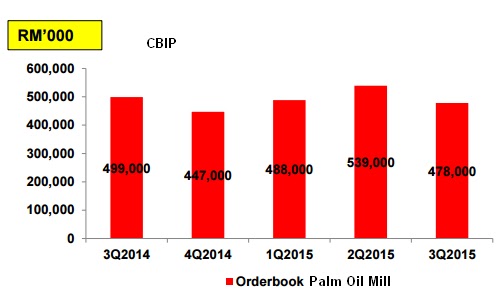
CBIP's POME's order book is quite stable. It can always maintain the outstanding orders value at above RM400mil with consistent new orders.


Up to today (end Dec15), it has secured about RM450mil of new orders in 2015 and its latest outstanding orderbook stands at above RM550mil

However, this figure only represents about one year plus of earning visibility as its revenue from POME segment a year is about RM400mil.

Its Modipalm POM pioneer status has expired since Feb15 so its effective tax rate has normalised to 25%.

Previously the company's tax rate was just around 7%.

So, its latest 2 quarters' net profits have reduced significantly due to higher tax rate.


Nevertheless, it is expected to regain the pioneer tax status with its zero discharge waste management system for its POME division.


CBIP's RSPV division is about designing, manufacturing and maintaining special purpose vehicles such as ambulance, fire fighting, utility, military vehicles etc.

It contributes less than 20% of CBIP's revenue and even less in profit attributable to common shareholders as 49% net profit in this division will go to minority interest.

Personally I don't really like this division and will just ignore it. It will become more negligible when contribution from plantation starts to grow.


I opine that CBIP's management team is great. The company's cash flow and balance sheet is also strong.

Despite "poor" financial results in the last 2 quarters, CBIP's share price does not drop. This shows that most investors know this company well, and know what to expect.

At RM2.03 now, it is trading at actual PE of 11.5x, and potential forward PE of more than 15x.

The company bought back it shares regularly since mid-2015, which might show that the management thinks the company is undervalued at below RM2.

Without a doubt, CBIP is a solid company and worth for long term investment. 

Its 86,000 ha of plantation landbank is not a small size.

However, investors might not see desirable growth perhaps until year 2018, which is an "inauspicious" year which marks the 10 years anniversary of global financial crisis.

The positive catalyst for CBIP in the near term should be the pending new pioneer tax status for its POM.

I'm not sure when can it be approved since the government seems to look for more money frantically from anywhere possible to counter its reducing income.

The negative aspect of CBIP's plantation might be its slow new planting. 

Though it plans for 6,000 ha new planting a year, so far it only planted 500 ha in 2015. That's way out of target.

If it continues like that, then I think its attractiveness will be reduced.

Though I still do not own any CBIP shares, I foresee that I will be part of the company in the future.

Thursday, 10 December 2015

Oil Palm Rising Star: MKH

MKH, a property developer based in Klang Valley, diversified into oil palm plantation in Jan 2008 when it acquired 100% of SJL Utama Pte Ltd which has 95% stake in PT Khaleda Agroprima Malindo who owns 15,942 hectares of plantation land in East Kalimantan.

It started its planting program straight away and it was completed in just 4 years time.

The table below shows MKH's total planted area reported in its annual report.

Year New Planting (ha) Total Planting (ha)
2008 3500 3500
2009 6000 9500
2010 4300 13800
2011 1400 15200
* Total planted area revised to 14,400ha in 2013


Its first palm oil mill with capacity of 60MT/hour was completed in 2011.

CPO was first produced and sold in year 2012 which generated its first revenue from plantation at RM44.9mil.

It was also the first time its operating profit turned positive (RM660k) since it ventured into plantation business 5 years ago.

In FY2013 (ended 30 Sep13), MKH revised its total planted area to 14,400 ha, down from 15,200 ha reported previously.

Its FFB yield improved to 16.0 MT/ha in 2013 from 11.6 MT/ha in 2012 as more trees turned mature.

Its OER also rose from 19.5% to 21.7% in the same period of time.

In FY2014, its FFB yield and OER improved further to 21 MT/ha and 22% respectively.

FFB harvested in FY14 stood at 295,000MT, up from 222,000MT a year ago.

The figure reached 370,000MT in FY15.

It has also completed its POM upgrade to 90 MT/h in 2014.

CPO & palm kernel sales volume increased from 76,600MT in FY14 to 108,900MT in FY15.

The table below shows MKH's past performance in its plantation segment (in RM mil):

FY Revenue PBT PAT Adj PBT
08 0 -2.4 -2.3
09 0 -4.6 -5
10 0 -4.5 -4.3
11 0 -8.7 -6
12 44.9 0.07 -1.6
13 101.1 -44.9 -36.9 4.7
14 164.8 22.2 14.9 40.3
15* 209.5 -29.7
7.3
* not audited


As expected, revenue from plantation segment increased progressively & brilliantly since year 2012 as more trees entered maturity.

However, its earnings were quite disappointing as it suffered pre-tax losses most of the time due to forex loss caused by significant weakening of IDR & MYR against USD in recent years.

Excluding this forex loss, it actually registered pre-tax profit in 4 consecutive years since FY12.

Its adjusted PBT (exclude forex) in most recent FY15 dropped 80% compared to FY14 despite higher revenue, mainly due to significant weakening of CPO price.

So, oil palm plantation business could be unpredictable because of fluctuating CPO price and forex issue as debt is usually high due to high capex.


As a rule of thumb, we expect oil palm tree to become mature and ready for harvest after 3 years (young mature) and reach prime mature after 8 years.

Since MKH started planting in 2008 and completed planting in 2011, its tree age will range from 5 to 8 years old now in 2015.

All the trees started to be harvested but most still haven't reach prime age.

So we can expect its FFB production to grow further for another 3-4 years until it reaches a plateau.

I think FFB yield of 25 MT/ha once fully matured is a very good yield. If we apply this yield to MKH's 14,400 ha plantation size, we can get 360,000MT a year.

However, its FFB produced is already at 370,000MT in FY15 even the trees are not in their prime age...


Subsequently , MKH will enjoy the recurring income from sales of CPO/kernel with minimal extra cost for another 15-20 years.

If the CPO price is high, then it will earn more. If CPO price fall, it will earn less.

I feel that MKH is an efficient planter as it could finished its planting program as planned. Most planters set a planting target but ends up planting less than half of target.

Besides, its FFB yield and OER are quite impressive given the fact of its average tree age is just about 6-7 years.

The less attractive part of MKH's plantation segment is that it has stopped planting since 2012 as there is no more plantation landbank.

Its 14,400 ha of plantation size is also relatively small.

It might acquire more landbank for plantation in the future but the growth has been interrupted.

MKH is supposed to to have a tough time in 2015 as both property and plantation sectors in Malaysia are suffering during this time.

However, its property segment actually did extremely well with record-breaking sales of RM850mil in FY15, up from about RM820mil in FY13.


Its property unbilled sales also reached a record high at RM920mil as at end of Sep15, compared to RM823mil at end of FY14.

So, we can expect its core profit to increase in the next few years, contributed by both property & plantation segments.

MKH recently expanded its development landbank by acquiring 130 acres of land in Kajang for RM239mil which is payable to land owners in 8 years.

This land has an estimated GDV of RM1bil and it will boost MKH's future GDV to RM12bil.

Its recent collaboration with PanaHome also looks interesting.


For its FY15 ended Sep15, MKH's revenue breached RM1bil mark for the first time, but PATAMI drops 17.5% from RM104.7mil to RM86.3mil.


However, FY15 is undoubtedly its best year if we factor in higher forex loss of RM37mil in its plantation segment (RM18mil loss in FY14) and lower fair value gain of RM9mil in its hotel/property investment segment (RM22mil gain in FY14). 

As I don't expect MYR/IDR to weaken like 2015 in 2016, MKH's bottom line is very likely to break new high in the next 2 years.

Personally I would expect its FY16 PATAMI to be at least RM100mil. This means projected EPS of at least 23.8sen base on 420mil shares.

As at end FY15, its net debt/equity ratio is 0.48, NTA RM2.63 and its operating cash flow is good.

Current share price of RM2.34 is not too high in my opinion.

After breaking new property sales record, can it better it or at least maintain this sales level in the coming years? This remains a little concern to me.

However, with its strategic landbank and high future GDV, the long term prospect of its property segment should be good.

As for its plantation segment, it's in autopilot mode.

Saturday, 20 December 2014

Brief Notes On Current Economy Situation

Investors are told by experts to read more investment books and financial news in newspaper.

Do I read a lot? Actually not.

I only read a few books on investment for the past 3-4 years, which includes the 2 books by "Cold Eye", one on basic accounting and another 2 books on stock market investment.

I never read a single book about Warren Buffet and other famous investors, or other famous investment books such as Millionaire Next Door etc.

I do read one book from the Rich Dad's series though. That was long time ago.

I read newspapers almost everyday, but ONLY the Sports column. I find that I'm actually not too interested to read financial news. This is bad, I know.

I may flip through financial news on newspapers a few times a week, but I mainly read local financial news only.

I am still new to those financial jargon & the law of economy. You don't expect me to read something that I don't understand, right?

I get the financial & business news mainly online from i3investor and The Edge, but I only choose a few to read, as I'm not able to get online frequently now.

To force myself to read more, I started to subscribe to Busy Weekly in Nov14 when they were doing the offer. Til now there are a few editions that I didn't even read a single page.

So do not always agree with me. I still have many things to learn.


In order to become a better investor, I know that I need to force myself to swallow more world financial & economy news. It's not easy frankly.

I will write down my own view on current world economy in this blog so that it can serve as reference in the future.


Before Oct 2014, I thought that there was no reason for a bear market in 2015. The impression I get from financial news was that US & Europe were in the process of recovery.

The only concern might be China, who may face a slow down in growth.

Now with the unexpected drastic drop in crude oil price, the whole picture seems to change.

In order to eliminate competition from high-cost shale oil producers in North America, OPEC decided not to reduce their oil production.

As a result, crude oil price continue to drop.

Those net crude oil exporting countries are feeling the heat, including OPEC members.

Russia's situation is scary, with a double blow from the drop of crude oil price plus the effect of economy sanction by the West.

Its currency Ruble has crashed from 1 USD:35 RUB to over 70+RUB at one point in just a few months time.

It is a 100% drop. Just imagine if USD/MYR suddenly depreciates from RM3.20 to RM6.00...

To check the continuous depreciation of Ruble against USD, Russia central bank recently raised its interest rate from 10.5% to 17.0% overnight!

If this happens in Malaysia, I think many Malaysian with high debts including me will "mampus".


If Russia goes bankrupt, will it drag the whole world into recession? 

I remember few years back when a few small countries in Europe faced the similar threat, it seems like everyone is panic and the whole world will be seriously affected.

However, I read some reports saying that Russia's collapse will not affect the world much as it mainly exports energy which can be substituted by other countries.

So is Greece more important than Russia? I don't know.

One local economy & financial expert with PhD title writes a series of articles regarding current & future economy outlook. He predicts that the next 2 years will be really really bad for Malaysia. 

After reading those articles which seem to make sense, I feel like I should dump all my shares and hold cash for the next 1-2 years.

Anyway, no one can predict the market accurately, and sometimes theory is just a theory.

Ringgit has depreciated almost 10% in 3 months time to RM3.50. It will benefit USD-based exporters and burden the importers and those companies with debts denominated in USD.

How will it affect the whole country in general?


With the fall in crude oil price, Malaysia as a net exporter is expected to suffer due to its "not-so-healthy" financial situation. 

Petronas will cut its capex by 15-20% next year and hence government income from Petronas will also go down. 

Its CEO told reporters in the end of Nov14 that payment to government could be 37% lower if oil stays around USD75 per barrel.

Petronas contributes about half of Malaysia government's revenue, and now the oil price is even lower at around USD60. It may still go lower.

However, the fuel subsidy has been abolished since Dec14 and GST will kick in from Apr15. No one can be sure whether the government can sail through the low crude oil price environment peacefully.

If the government has difficulty to cope, then a lot of major projects have to be put on hold I guess. It will affect a lot of sectors.

Thus, foreign investors started to flee Malaysia. KLCI slumped and Malaysia Ringgit depreciated, while most other regional stock markets gain.

US and Euro markets are busy breaking new highs. Why KLCI does not follow US anymore? When US economy is good, other countries' economy can be bad?

Actually US did not suffer much during Asian Financial Crisis in 1997-98. 


       Dow Jones Index since 1985


In the end of Oct14, US just ended its 5-year quantitative easing programme (QE) as its economy has improved.

At the same time, Japan announced that it will further expand its own QE in response to an ailing economy. This makes many people planning a Japan holiday trip next year as Yen has depreciated quite a lot against MYR now.

China surprised everyone by cutting its lending interest rate for the first time in 2 years to 5.6% in order to tackle sluggish growth.

Eurozone is also hinting to implement a large scale QE to give a push to its slow recovery.

Because of the reasons above, aided by low crude oil price, stock markets of those economy powerhouse such as US, Euro, China & Japan are expected to advance next year!


Besides, US Fed is also highly anticipated to raise the country's interest rate in 2015 for the first time since 2006. Its current rate is only at 0.25% for quite a number of years already.


       US Historical Interest Rate


Raised interest rate in US is said to further strengthen USD, and may give further pressure to other countries' currencies.

Low interest rate environment means lower cost of living. People can buy houses, cars etc more easily with low borrowing cost.

Sooner or later this will lead to inflation when demand is more than supply. This is when interest rate hike comes in.

I get an impression from certain articles that US rate hike will have negative impact to Malaysia & KLCI. Will it happen suddenly in 2015, or gradually over many years? 

It is just a start of interest hike, should we need to worry now?

As Ringgit is cheap now, isn't it attractive for foreign investors to invest in Malaysia? Of course Malaysia need to be in a good shape to attract foreign investment.


For the past one year, it is obvious that crude oil, crude palm oil & KLCI all retreats from its recent peak in mid-2014.


Brent crude oil price started to drop from its peak in July14, which coincided with KLCI. However, CPO price started to trend downward earlier since Mac14.


For the past 10 years, during the bear market in 2008, all three reached their peaks in early 2008 before the massive slump which found their bottom at the turn of year 2009.


After that, both CO & CPO rebounded and reached their peaks in early 2011.

From there, crude oil fluctuated around USD110 for 3 years+ until the sudden fall recently, whereas CPO price was in a gradual downtrend.

Nevertheless, KLCI did not follow this time. It only experienced a major correction in 2011 but kept on breaking new high after this.

I think it is the same for almost all major stock markets around the world.

So now, crude oil at USD60 is very close to its lowest level during 2008 crisis at around USD50. CPO at RM2100 now from its peak of RM3800 is also quite close to RM1600 in 2008.

Despite a drop of 10% from its peak in July14, KLCI at 1700 now is still far away from lowest point of 800+ in year 2008.

As economy has largely improved, I think it is unlikely to touch that level again in the next bear market.


Anyway, during the period of 1997-2000, KLCI and CPO price actually moved in different direction.


It seems like rosy outlook suddenly turns sour towards the end of 2014. This is how fast things (or emotion?) can change.

As an investor, I think it is important to learn from experience and do not forget our initial investment strategy.

If you have got a few sleepless nights or near heart attacks for the past few days, then you might need to review and change your strategy to one that suits you better.

When we step into the year of 2015, will things turn better or worse?

If it becomes better, then it's nice.

If it becomes worse, then it's opportunity.

But you need to have enough CASH of course.

Tuesday, 24 June 2014

Boustead Plantation IPO: Is RM1.60 Certainly A Good Price?

Boustead Plantation (BPLANT) is going to be listed in 2 days time on  26th June 2014. It seems to be in a good timing as plantation sector is gaining upward momentum because CPO price is expected to move up further.

BPLANT will raise RM1.05bil from its IPO at RM1.60 per share. Its total paid-up shares will be 1.6 billion after some corporate exercises and then IPO.

Is BPLANT a good company to invest in?


Specifically for a plantation company, I would look more into a few criteria such as:
  • Growth prospect
    • Unplanted reserve
    • Tree age profile
    • Replanting strategy
  • Management efficacy
    • FFB yield
    • OER
    • Gross margin 

Boustead's Estates & Mills:

  • Total 41 plantation estates & 10 palm oil mills (all in Malaysia)
  • Total 86,363 ha of land (70,991 ha planted, 5,494 ha unplanted)
  • Total mills capacity 415 MT/hour or 1.96mil MT/year

The unplanted land reserve is limited...


Tree age profile:

Age profile Years %
Immature 0 – 3 7.4
Young mature 4 – 9 16.6
Prime mature 10 – 20 59.3
Past prime 21 – 25 15.8
Replanting > 25 0.9


From the age profile above, its future growth potential is not so exciting, as 76% of trees are already at or over prime age.


Expansion:

  • Plan to expand by 10,000 ha in 3 years, 20,000 ha in 5 years
  • Plan to replant 4,375 ha in year 2014/15

It is a 15-30% expansion of plantation area in 3-5 years.


       Location of estates & mills


For me, BPLANT's future growth is not exciting. Anyway, how efficient is BPLANT running its estates & mills?


FFB yield:

  • With high percentage of mature trees, its overall FFB yield is still below national benchmark. Not impressive.


OER:

  • Overall OER is slightly above national benchmark from 2011 to 2013. This is good.


Gross margin:

  • BPLANT's gross margin 2011: 33.3%, 2012: 22.4%, 2013: 15.1%. It is in declining trend to a lowish 15%. The low CPO price surely has a major effect on it.
  • Compared to gross margin of some peers chosen randomly (year 2013 figures), BPLANT is not good but not too bad either.

    • UTDPLT: 39.5%
    • KULIM: 32.1%
    • THPLANT: 24.7%
    • IJMPLANT: 23.7%
    • KMLOONG: 19.4%
    • IOICORP: 18.1%
    • BPLANT: 15.1%
    • KLK: 12.5%
    • SOP: 10.5%
    • FGV: 7.0%
    • BLDPLANT: 6.0%


Lets check how did BPLANT perform for the past 3 years.


FFB & CPO production:

  • FFB & CPO production are flat from 2011 to 2013, as 75% of trees are in prime age and may be biological tree stress from dry weather in 2013.


Financial results:

  • Revenue & gross profit are declining from 2011 to 2013, due to weak CPO price & no growth in FFB/CPO production
  • PATAMI rose YoY in 2013 mainly due to a RM92.8mil gain on disposal of plantation assets.
  • ROE in 2013 is at a decent 11.6% but it is also heavily affected by the special gain.


Debts at 31 Dec 2013:

  • Cash: RM32.3mil, Loans: RM977.4mil, Net D/E: 0.53
  • After IPO, Cash: RM587.2mil, Loans: RM977.4mil, Net D/E: 0.17


Overall, BPLANT's recent performance is only average for me.

Is the company worth to invest in? Is the IPO price fair?

Its net asset per share after IPO is RM1.43, so the IPO price at RM1.60 is 12% higher.

Base on 2013 earning of RM161.5mil, EPS of 2013 will be 10.1sen. Thus PE ratio at RM1.60 per share is 15.8x. Because of this, the director said that IPO at RM1.60 "is certainly a good price".

However, as mentioned earlier there was a one-time special gain of RM92.8mil in 2013. Without this huge special gain and with high finance cost in 2013, I think BPLANT's PATAMI should be around RM80mil. 

So the EPS should be cut by half to 5sen and PE at RM1.60 per share should double to 32x.

Anyway, CPO price has advanced in 2014 and BPLANT's earning should pick up as well.

HLIB has projected BPLANT's core net profit in 2014 to be RM119.9mil. With this figure, EPS is 7.5sen and target price will be RM1.13 if fair PE is 15x.

BPLANT has just announced its FY14Q1 results. Its PATAMI of RM30.1mil is a good 36% higher than previous year's RM22.1mil.

However, revenue just increases by 3.3% YoY to RM198.6mil. Higher CPO price YoY but flat revenue, has FFB & CPO production dropped??

Anyway, gross margin improves to a good 27.5% which is great. 

If we annualize the PATAMI, it will be RM120mil for FY14 which is similar to HLIB's forecast above.


       Boustead Plantation CEO & Chairman


So for me, BPLANT at RM1.60 is not a good price, unless it has a very strong growth prospect with many immature/young trees or eye-popping acquisition. However, it is not the case.

The only good surprise is its dividend payout policy of at least 60% of net profit. If it were to register RM120mil net profit in FY2014, then dividend will be at least RM72mil or 4.5sen per share. 

Nevertheless, this works out to be only 2.8% dividend yield at IPO price of RM1.60.

With this high dividend payout, it is also unlikely that the company will grow in an aggressive way, even with the money from IPO.

Overall, BPLANT is not a bad company. It's just not my cup of tea in term of investment as I like growth more. 

Almost all plantation stocks are traded at high PE well above 15 currently. So RM1.60 for BPLANT might seem to be fair. To invest in it or not will depend very much on your investment style.

Friday, 28 March 2014

FirstRes vs Bumitama vs TSH

After screening through 10 plantation companies with high potential of growth, I finally come out with 3 companies that I like, which are First Resources, Bumitama & TSH.

To know why am I choosing these three companies, you can refer to Part 1 and Part 2 of Plantation Companies With Best Growth Potential.

I know that there may be other plantation companies which are actually better than these three, or some other companies with even higher percentage of immature trees such as MKH and Innoprise etc. There may be also many other good ones listed in Indonesia.

However, I'm not expecting that I can pick up the best from the market. I just study a few of them. As long as it is good enough to meet my selection criteria, I'm ready to bear the outcome of my investment, no matter it is a good or bad decision.


In order to pick one out of three, I have to compare them head to head. Unfortunately, I can't get a lot of information for TSH.

TSH's annual reports and websites are not "investor-friendly" at all, in which some important plantation productivity data such as historical FFB yield, OER etc are missing.


First, lets compare the total planted area, FFB, CPO & palm kernel production of these 3 companies.


Though to me Bumitama is more like a newcomer and First Resources is quite an "established" company in plantation industry, their total planted area are actually quite close and also increase at almost similar rate yearly. 

As we will see later, the much lower revenue and profit for Bumitama is mainly due to less percentage of mature trees (less FFB produced) and less superior margin.

TSH is much smaller in term of total planted area.


Bumitama actually has more immature plantation area in hectare compared to First Resources. The immature area makes up 32% of its total planted area. Furthermore, its young mature trees below 7 years old at 43% makes Bumitama a more likely candidate for exponential growth in the next few years.


Both First Resources and TSH have huge unplanted land, which can sustain the companies' growth for many years to come. Bumitama has less but still quite a big number of unplanted land at 60,000ha. If it carries out ~10,000ha new planting a year, it can still last for a good 6-7 years. Anyway, the planned new planting for Bumitama in FY2014 is 8,000ha.


Without surprise, First Resources has the highest number of FFB produced due to its larger mature plantation. However, it is noteworthy that Bumitama's line is slightly steeper than the other two, which means Bumitama's FFB production grows slightly faster.


Bumitama achieves higher 4-Year CAGR (compound annual growth rate) in total planted area & FFB production compared to First Resources. Thus, Bumitama grows faster than First Resources from 2009 to 2013, especially its FFB production which achieves 30.5% 4Y-CAGR.

TSH's FFB also grows at 4Y-CAGR of 24.2% but I don't have its figure for total planted area.


Similar to FFB production, Bumitama's CPO production seems to grow at a faster pace compared to First Resources.


Palm kernel production grows in more even pace between the two.


First Resources has the largest palm oil mill capacity at 4.05mil tonnes per annum in 2013, besides also having downstream refinery facilities which contributed 9% of its total EBITDA in FY2012. Its newly constructed integrated processing complex at Riau even has a private jetty.

Both Bumitama and TSH are pure upstream plantation players.


Next, lets look at the efficiency of these companies in term of their plantation management.


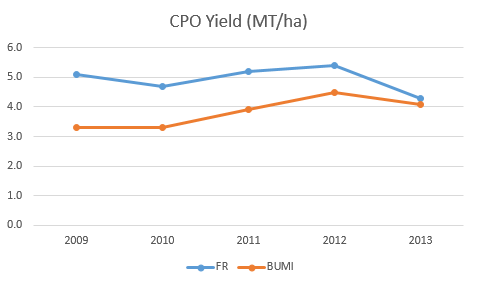
The FFB yield of First Resources and Bumitama fell in FY2013 ended 31st Dec 2013, mainly due to biological tree stress. However, Bumitama seems to suffer less and was improving year by year before 2013.

Even though Bumitama's FFB yield figures are not high over 20, they are considered quite impressive as they are achieved from very young trees with weighted average age of just around 6 years. First Resources weighted average tree age is about 8 years.

I don't have TSH's historical 5 years figure but TSH is generally well-known for its high FFB yield among its peers. Its year 2011 FFB yield stood at 24.9 MT/ha, which was the highest among the three. It was reported earlier this month that TSH's trees have a weighted average age of about 8 years.


First Resources's CPO yield is not excluded from a fall similar to its FFB yield, so to Bumitama.


It is a surprise that Bumitama's OER has overtaken First Resources since year 2011. First Resources's OER seems to fall slowly throughout the past 5 years.


Kernel extract rate remain flat for both First Resources and Bumitama.

Since CPO price was depressed from mid 2012 to 2013, it is good to see how did it affect the companies' revenue and profit. The gross margin and net profit margin also show how efficient these companies are managed.


It is quite surprising that TSH's revenue in 2009 (RM980mil) was higher than First Resources and Bumitama, as its FFB production is only half of the latter and way way below the former in 2009. 

Actually TSH has contribution from other businesses such as cocoa, timber and wood products. Its revenue from sales of palm products in 2009 was actually RM770mil, but this was still more than First Resources (RM722mil) & Bumitama (RM414mil).


Anyway, TSH's revenue was almost flat around RM1 billion from 2009 to 2013, while both First Resources and Bumitama achieved persistent growth in revenue. 

First Resources's revenue seems to grow faster than Bumitama. This might be due to the effect of locked-in CPO forward sales at a high average selling price of RM2850/MT throughout year 2012-2013. Bumitama should also have its own locked-in CPO forward sales, but analyst did not point this out so I think it might not be that significantly high. The CPO average selling price for Bumitama in 2013 is estimated to be RM2500/MT only.


Thanks to its extraordinarily high margin, First Resources enjoys much higher net profit compared to Bumitama & TSH. 

The PATAMI presented here is WITHOUT the gain in biological assets value for First Resources and Bumitama. Other than the dip in 2010, Bumitama achieves a decent growth in PATAMI.

It is important to note that there is a special one-off gain amounting to RM85.3mil in TSH's FY13Q3 profit through disposal of stake in Pontian United. However, it also suffered a forex loss of RM43.7mil in the same period.

However, TSH's overall FY13 core profit of RM140.2mil, which is only slightly lower than its reported PATAMI of RM153.1, still beats consensus estimates.

All three seem to weather the period of low CPO price quite well with their growing FFB production.


Overall from 2009 to 2013, First Resources and Bumitama have the same growth in revenue, but Bumitama beats First Resources in PATAMI growth.


Even it drops a bit for the past 2 years, First Resources's gross margin is still far superior than the others. Bumitama's gross margin is flat while TSH improves significantly in year 2013.

Lastly, lets compare their debt level and ROE.


It is clear that First Resources is able to control its debt well, while both Bumitama and TSH have almost similar net debt/equity ratio in 2013. However, with the expectation of more profit due to higher FFB production and CPO price, the gearing ratio is expected to ease in coming years.

Anyway, all three will still carry out quite aggressive new planting and acquisition, which may need lots of capex.


First Resources undoubtedly has the highest ROE which is improving from year to year. Bumitama and TSH are also excellent at around 15. Profit arising from fair value gain in biological assets is excluded in  the calculation of ROE here.

I think that First Resources's earning will still grow in the next few years, but there is a concern that it might not grow as well as the other two even though CPO price is trending up. I predict Bumitama and TSH to have better earning growth and thus better share price appreciation.

Nevertheless, First Resources is currently trading at lower PE ratio compared to the other two. So this may somehow make all of them equally attractive to investors at the moment.


About which one to choose, I think three of them have their own plus and minus. If you are more conservative, then can go for more established & "stable" First Resources. If you want more growth, then can go for either TSH or Bumitama. 

Bumitama has more percentage of young mature trees but less percentage of immature trees compared to TSH. It also has better margin and growth story. Both companies' gearing ratio and ROE are quite similar in 2013.

However, TSH should have better FFB & CPO yield compared to Bumitama. Also, don't forget its Wakuba ramet planted commercially since 2012. Research shows that it can improve the yield (and thus, profit) substantially.

In conclusion, First Resources, Bumitama & TSH Resources are all good.

It is important to note that the Indonesian government has passed a new regulation in Oct 2013 which restricts oil palm planters to no more than 100,000ha of plantation in the country. Those who already have plantation land more than 100,000ha now are allowed to plant more than 100,000, but will not be able to buy further land for new planting. 

This will surely affect many plantation companies negatively especially those with more than or close to 100,000ha oil palm plantation but with very limited land reserved for new planting. However, those overseas companies who still yet to venture into Indonesia may benefit from it as there will be less competition.

Thus, those affected companies may look elsewhere to further expand their plantation. They may move to Papua province which they can have plantation area up to 200,000ha, or pursue new planting in other countries such as Papua New Guinea and Africa.

In this circumstances, I think those companies with good management and comfortable gearing may have the upper hand in future growth.