Tuesday, 30 June 2020

Green Packet's Revenue Jumps 50% in Q1 to RM147mil


From the title above, I guess all readers will think that GPacket has a great financial quarter.

However, when you try to find out how much profit it made, you might vomit blood.


Revenue increased 50% YoY but it suffered loss after tax of RM35mil.

OK, there's one-off item inside. Without it, the EBIDTA is still a loss of RM11mil and the loss has widened YoY, perhaps affected by Covid-19.

It's actually not a surprise at all when GPacket reported a loss-making result, I think investors are already used to it.

What I want to bring out here is why "The Star" is helping GPacket to "beautify" the report?

I have seen news title like this before in which revenue or profit increases by so much and so much but actually QoQ everyone knows that it's a very bad result.

For example, previous year similar quarter (YoY) profit was RM1mil and current quarter profit at RM2mil, the news title will be "100% increase in profit" or "profit doubled", but the usual quarterly profit is at RM10mil.

This result of RM2mil profit is a "gap-down" result by current standard.

This time The Star seems to deliberately and totally ignore the loss-making part. The whole article only talks about how much revenue has increased in all the business segment and doesn't mention whether it is making a profit or a loss.

I don't mean that GPacket is a bad company. Its revenue increases significantly and it seems to be in the right industry of AI, digital and communication service.

However, there must be a reason why it's always hard to make profit, and I think I know the reason.

Saturday, 27 June 2020

A Different Bear in 2020

Back in May, I heard that someone who has never buy any shares in stock market before, earns more than RM300,000 in gloves stocks.

He just needs to follow his friends and "online teachers" to trade. Making money is so easy in stock market.

It's a fact that the stock market welcomes a lot of newcomers like him during this Covid-19-induced bear market.

Despite how the indexes drop in record pace and how bad the economy data show, the stock market staged a quick V-shape recovery.

This stock market & economy forecast mismatch is certainly contributed by technology - the ease to communicate and trade in stock market.

Back in the 1990s while many were joining the euphoria in shares trading, there were no smartphones, chat groups, Facebook etc. I doubt there was any online trading platform at that time with the super slow dial-up internet connection.

We had fixed line phones and remisiers. When you want to buy or sell shares, you have to call your remisier and queue up. I can imagine how difficult it was to get in contact with the remisiers when the market was hot.

Many investors and speculators did not have real time share price in front of their eyes. My parent bought a small Sony TV with Teletext just to follow the share price movement. It attracted lots of friends and relatives to "watch" this TV.


It must be a best-seller at that time.

There was no smartphone with data and no online trading platform to view the share price and trade the shares at a few clicks. There were no social medias in which investors and traders could share information, news and more importantly, tips & "insider news".

So when the market crashed in 1997, people just threw their shares out of the fear of unknown and many retail investors just left the stock market forever.

Ten years later during the market crash in 2008, online trading was definitely there but still not widely used. Hand phones were more common but they were not "smartphones". Even with a smartphone, data was often limited and I guess mobile phone trading was still not there.

Nokia, Ericsson, Blackberry etc still ruled the market at that time.

There were still no phone-data based messaging and chat groups like Whatsapp, while Facebook was not that "commercialized" and popular.

Stock trading can be done quite easily online through a computer though. However, if you don't have a computer around you, you can't do trading unless you call your remisier or agent.

This time in 2020, it's totally different. Every adults including foreign workers has a smartphone and phone data is getting cheaper and cheaper. People use smartphones to trade which is as easy as ABC. You can trade even when doing your business in the toilet.

Social medias are now widely used to communicate and share information. Once a guru says "buy", the message spreads like wildfire and immediately share price will go up. Once a sell call is made, share price can immediately drop, at least temporarily.

This is a world where information can be obtained easily through internet. Everyone is aware that a stock market crash will eventually rebound. Everyone knows that the best time to buy shares is during a bear market.

If you don't know about all these, very quickly you will know as you will find them on your Facebook or Whatsapp or others. Someone made a good profit and might share it out. Hundreds of newcomers know it and wish to follow the footstep.

It's just like that "someone" who does not have a clue about stock market but earns RM300,000, he might have been attracted into the stock market after hearing or reading something from his friends or relatives..

Stock markets worldwide are supposed to be bad at this point of time. However, they are not. 

Retail participation has increased significantly during this time and certainly plays a part in the rebound while neutralizing the effect of foreign funds exit. 


Trade statistics of May 2020 shows that local retail investors contributed more than local institutions in term of either value (32.4% vs 28.7%) or volume (45.3% vs 23%). Though I never track such statistics, I read that retail participation usually does not exceed 20%.

"Local Nominees" also make up a big portion of the trades. I wonder whether retail investors who open a nominee account are included here. If it is, then almost half of the stock market is "controlled" by retail investors or speculators.

Now we are coming towards the end of Jun and the stock market seems to lose some steam.

When more businesses shut down and unemployment figure rise inevitably, will the stock market still be resilient? We won't know.

For someone who just came in the stock market and earned RM300,000 in less than a month, definitely he won't stop here.

If he is to stay long in the stock market, perhaps he should learn the fundamentals of stock market investment, either by self-study or paid lessons. If not, someday he might end up like a lot of people who don't even want to talk about shares after 1997-98.


Sunday, 21 June 2020

JAKS: Cash Cow In The Making?

Readers who follow this blog long enough should know that I invested in Jaks before. I bought in Feb17 but sold all in Nov17.

I bought Jaks because of its Vietnam power plant venture. It is a 2 x 600MW coal fired thermal power plant in Hai Duong with a BOT of 25 years. Jaks owns 30% shares in the JV with CPECC of China, with an option to increase the shares to 40%.

At that time, I didn't know how to predict the profit to Jaks when the plants are ready and running. I just knew that Jaks will pocket 100% the USD454.5mil (~RM1.8 billion) EPC contract.

The reason I invested in Jaks back in 2017 was simply because of this EPCC. It started to register good profit from its construction of power plant in Vietnam. I predicted that such profit will continue to rise.

I was aware that Jaks was struggling a bit in its property development & investment arms but I didn't expect those issues to be dragged for so long.

Anyway I sold all the shares in Nov17 due to various reasons and rarely looked back at the stock.

Jak's share price swung wildly from RM1.80 to RM0.40 then went up to RM1.50, back to RM0.60 due to Covid-19 and around RM0.90 now after the announcement of rights issue.

A famous investor quickly became the largest shareholder and then exited completely, which contributed to the movement of the share price.

Now, the power plants are about to be ready in Q3 of 2020. Construction profit from Vietnam will stop but profit from sales of electricity to Vietnam government will start.

How much can Jaks profit from the sale of electricity?

I don't have any idea until I read the article posted by DK66 in i3investor.


**********************************************************************************


The most reliable earnings guidance from Vinh Tan 1 power plant

What makes the most reliable earnings forecast ?

Peer comparison is the most reliable and convincing method for making earnings forecast if the subject exhibits the following characteristics;
  • high degree of earnings stability and foreseeability
  • high degree of resemblance in operating terms and conditions

The higher the similarity between the subjects in comparison, the higher the accuracy of forecast.

Peer comparison evaluation method alleviates the need for making excessive adjustments, assumptions and projections which in most cases would cloud the integrity of the results derived. It is often derived from actual operation of businesses under terms and conditions which may not be well understood or considered by the evaluators of other methodologies. In other words, it is the most realistic forecast of earnings potential of a company operating under the same geographical roof. 


Vinh Tan 1 Thermal Power Plant

It is located in Vietnam's southern province of Binh Thuan.

The coal-fired power plant includes two 620-MW super-critical generating units which is 55% owned by China Southern Power Grid, and constructed by CEEC. CEEC is the holding company of CPECC who is Jaks' partner in JHDP.

Vinh Tan achieved full commercial operation on 27th November 2018 (COD).


Why compare to Vinh Tan 1 ?

Hai Duong, Vinh Tan 1, and Mong Duong II are all 100% foreign owned power plants in Vietnam operating under 25 years BOT contracts with capacity around 1,200 MW. All their BOT contracts, power purchase agreements, coal supply agreements were signed around 2012.

Vinh Tan 1 is an extremely close model for Jaks Hai Duong power plant because; 
  1. Both were awarded by the Vietnam Government around 2011
  2. Both BOT contracts were signed with the Ministry of Industry and Trade (MOIT).
  3. Both are Coal fired power plants costing around US$1.8b
  4. Both around 1,200MW capacity
  5. Both are 100% foreign owned and operated by Chinese corporations
  6. Both are adopting chinese technology
  7. Both under 25 years Build-Operate-Transfer (BOT) scheme
  8. Both are guaranteed by Vietnam Government
  9. Both Power purchase agreements signed with EVN
  10. Both coal supply agreements signed with Vinacomin
  11. Both under USD1.4b bank financing
  12. Both under max 18 years loan tenure allowed by Vietnam government

Therefore, Vinh Tan 1 and JHDP should exhibit extreme high resemblance, if not identical.


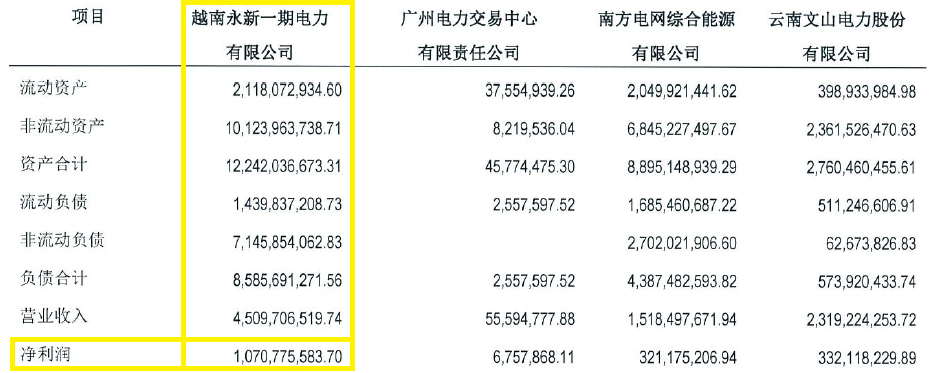
Extracted from the 2019 Annual Report of China Southern Power Grid Corporation

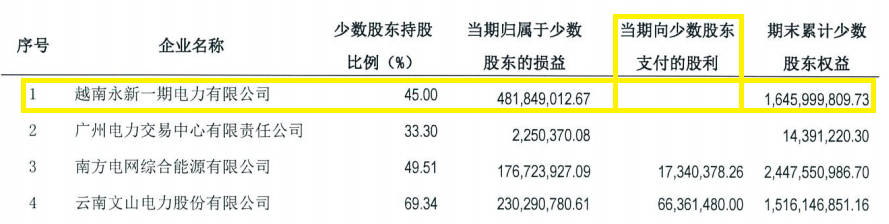
Profit attributable to minorities interest

Vinh Tan 1 = 越南永新一期电力有限公司 


This is the first full year operation results of Vinh Tan 1 since commercial operation in November 2018

Net profit after tax for 2019 = RMB1,071m = RM652m (RM/RMB conversion rate of 1.64)

Hence, potential earnings attributable to Jaks

@30% = RM652m x 30% = RM196m = EPS RM0.30

@40% = RM652m x 40% = RM261m = EPS RM0.40


Free Cash Flow


Annual free cash flow = RMB1,609m = RM981m (RM/RMB conversion rate of 1.64)

Hence, potential free cash flow attributable to Jaks

@30% = RM981m x 30% = RM294m = RM0.45 per share

@40% = RM981m x 40% = RM392m = RM0.60 per share


Dividend Distribution 


You may noticed that there was no distribution of dividend in 2019 despite healthy cash flow of RM981m. This is due to the need to build cash reserves requirements for bank installments, working capital, maintenance, coal inventory, and statutory reserves. Aggressive distribution policy is expected once the cash reserve requirements are met as evident in the case of Mong Duong II, another similar plant in Vietnam. Below is the distribution pattern of Mong duong II since commercial operation in April 2015. The amounts are converted to Malaysian Ringgit at 4.35 to USD.


Year   Q1      Q2       Q3      Q4          Total
2016            9m       74m    122m      205m
2017           109m               113m      222m
2018           117m               78m        195m
2019           122m   196m   13m        331m


2018 dividend distribution was affected by the restructuring of long term project borrowings to reduce future interest costs. This has resulted in a one time restructuring cost of USD31m.

Note that first major dividend distribution by Mong Duong II started after 15 months of operation. By the end of 2019, Vinh Tan 1 has 13 months of operation. Hence, Vinh Tan 1 is expected to start dividend distribution in 2020.


Reservations 

Vinh tan 1 has only provided one full year operating results for evaluation in this article. There is no information to whether there were any material extraordinary gains of losses included in the operating results. Nevertheless, the nature of the business of Vinh Tan 1 whch is stable and foreseeable with majority of its earnings derived from capacity payments mitigated such concern. Moreover, my previous studies provides further assurance of the results of Vinh Tan 1. 

Vinh Tan 1 classifies its power plant as concession asset instead of loan receivable as required by the new international accounting standard. Adoption of old accounting treatment has resulted in lower total earnings of Mong Duong II by USD203m since operation with its 2018 earnings increased by USD40m after adoption of new accounting standard. Since continuing with old accounting treatment does not lead to overstatement in earnings of Vinh Tan 1, the higher earnings effect to JHDP is disregarded in this article on prudent grounds.


Conclusions

Earnings guidance provided by Vinh Tan 1 is by far the most straight forward and reliable estimate of JHDP's future earnings potential. Most evaluation methods require assumptions or management guidance and complicated computations. It is difficult for those without sufficient knowledge of those methodologies to express confidence. 

Vinh Tan 1's earnings represents results from actual operation of a similar power plant in Vietnam which is also managed by a Chinese corporation. 

Vinh Tan 1's earnings jibes with my previous estimates derived using various valuation methods.

This article concludes that JHDP is expected to deliver EPS of between RM0.30 to RM0.40 to Jaks. At PE of 10 to 15 times, Jaks is worth between RM3 to RM6.

I hope this article has raised your level of confidence in Jaks significantly.

Thank you and happy investing !


DK66


**********************************************************************************


I think this is an excellent and insightful prediction on Jaks's potential profit from the power plant. With potential EPS of 30sen, it's RM3 if PE is 10x!

Not only this, the predicted free cash flow of close to RM300mil a year to Jaks is just superb. This is possible due to the high depreciation and amortization of the power plant.

Even if the profit contribution from Vietnam is only half at RM100mil a year, the potential EPS of 15sen is still good compared to current share price of around 90sen.


After being delayed due to Covid-19, it looks like the power plant is preparing to deliver its first electricity in July. Commercial generation is expected in September for the first unit, while the second unit is scheduled to run in January 2021.

Anyway, this is not a buy or sell recommendation on Jaks. Nothing is without risks. So, invest at own risk. 


Thursday, 18 June 2020

Jaks Worth Only 40sen?


On 22 May 2020, the share price of Jaks closed at RM1.03. 

Then it announced a corporate exercise of rights issue of shares (4 existing shares : 2 rights shares) and warrants (2 rights shares : 1 warrant).

The next trading day, its share price fell 15% to close at 87.5sen. 

I guess this type of reaction occurs to most cash calls as investors might be worry of the potential dilutive effect.

It might be the case in Jaks, and might also be possibly due the lowish illustrative price of Jaks rights shares at 40sen per share.

Public Bank quickly downgraded its target price substantially from RM1.13 to RM0.77 on "potential dilution of the cash call".

Obviously it will be a massive 50% increase in outstanding shares immediately, and potentially up to 75% when all the new warrants are converted into shares. EPS will be adjusted lower by 33% & 43% respectively. 

However, is there any dilution effect on shareholders' holding?

If I cut a large pizza into 4 equal pieces and I get one piece, I have 25% share.

Then there is a second pizza which is half the size of the first pizza up for sale. It is cut into 4 equal pieces as well and I'm eligible to buy one piece or 25% of it. Even though this piece is 50% smaller than the first one, it's still a 25% share for me.

Then I am given a voucher to buy 25% of a new pizza which is only a quarter of the size of the first large pizza. If I use the voucher to buy it, my overall share in these 3 pizzas is still 25%.


There are more pizzas now, but I still have 25% of all of them. So, there is no worry about the dilution effect for existing shareholders after the rights issue. 

Is it worth to buy those extra pizzas? If the pizzas are tasty and value for money, why not? If the pizzas taste terrible and are expensive, why should I buy more?

Even if you don't want to buy those extra pizzas, you can sell your rights and vouchers to get cash. You lose your shares but gain cash. 

The rights shares price is proposed at 40sen as illustrative purpose. The actual price will only be decided according to the latest share price when the final announcement is made. 

This 40sen does not mean that the true or expected value of Jaks share price is 40sen.

When the announcement was made on 22 May, the closing share price of Jaks was RM1.03, while the 5-day VWAMP (Volume Weighted Average Market Price) was RM1.07.

The price of rights share is usually determined by giving a discount to the TERP (Theoretical Ex-Rights Price).

TERP as its name suggests, is the theoretical adjusted share price after the rights issues are exercised. It is calculated as:


market value before rights issue + cash raised from rights issue
----------------------------------------------------------------------------
            total numbers of shares after rights issue


For Jaks case, the share price used to determine the market value is the 5-day VWAMP (RM1.07), while the outstanding shares that day was 651.1mil

market cap before rights issue =  RM696.7mil (651.1 x 1.07)
cash raised from rights issue =  RM130mil (325 x 0.40)
total shares after rights issue =  976.1mil (651.1 + 325)

TERP = RM0.85

The proposed rights share of 40sec each is a 52.94% discount to the TERP of 85sen.

The management mentions that rights share price will be at least 50% discount to the TERP. So it might change if the share price move substantially up or down from RM1.07 when the price fixing date arrives. 

I don't have a lot of experience regarding rights issue but I think it is common for such a huge "discount" given to the rights shares, even though in reality share price will also be adjusted accordingly so that shareholders do not get anything at "discount" or "free".

In other words, you may think that you get the rights shares cheap at 40sen and earn big from it immediately. Actually it's not, share price after the rights issue will be adjusted lower and you have nothing to gain or lose.

I have subscribed to Inari's rights issue with warrant before in year 2014. When the cash call was first announced in early July 2014, Inari's share price stood slightly above RM3, with 5-day VWAMP of RM3.09.

It was a 8:1 rights share + warrant. TERP was RM2.91 and the illustrative rights share price was just RM1.50, which was also around 50% discount to TERP.

Did Inari's share price fell to RM1.50? Of course no, not even close.

The final rights share price was fixed when the market share price was around RM3, so the rights share price was the same to the proposed figure of RM1.50.

For Dayang's rights issue in 2019, initially its proposed rights share price was at RM0.80, which was a 33% discount to TERP of RM1.14 and the 5-day VWAMP was RM1.23.

Dayang's share price initially dropped to around 90sen in respond to the cash call but later went up higher and higher to over RM2 before the rights issue ex-ed.

The final rights share price was fixed at RM0.92, with around 50% discount to TERP of RM1.83, while 5-day VWAMP was at RM1.92 which was 56% higher compared to the time when announcement was first made.

These show that rights shares offered at 50% discount to TERP is not uncommon.

Rights issues can be good or bad. If it is for good reasons, share price will likely go up. If not, share price will inevitably drop.

For Jaks, whether it's good or bad, it's up to you to decide.